5 Coffee Table Styling Mistakes That Make Your Living Room Look Cluttered
I used to think my coffee table was fine. Not styled, exactly, but fine: a candle here, a stack of mail there, whatever book I was in the middle of. Then a friend came over, set her purse down, and said, without any judgment in her voice at all, “Oh, I like what you did with the clutter.” She meant it kindly. I still think about it constantly. That one comment taught me more about styling a coffee table than any list of rules ever has, because it forced me to actually look at the surface instead of just adding to it. Most cluttered coffee tables aren’t the result of too little effort. They’re the result of effort aimed in the wrong direction. Here are the five mistakes I see most often, including the ones I made myself, and what actually fixes each one.
Mistake #1: Skipping the Tray
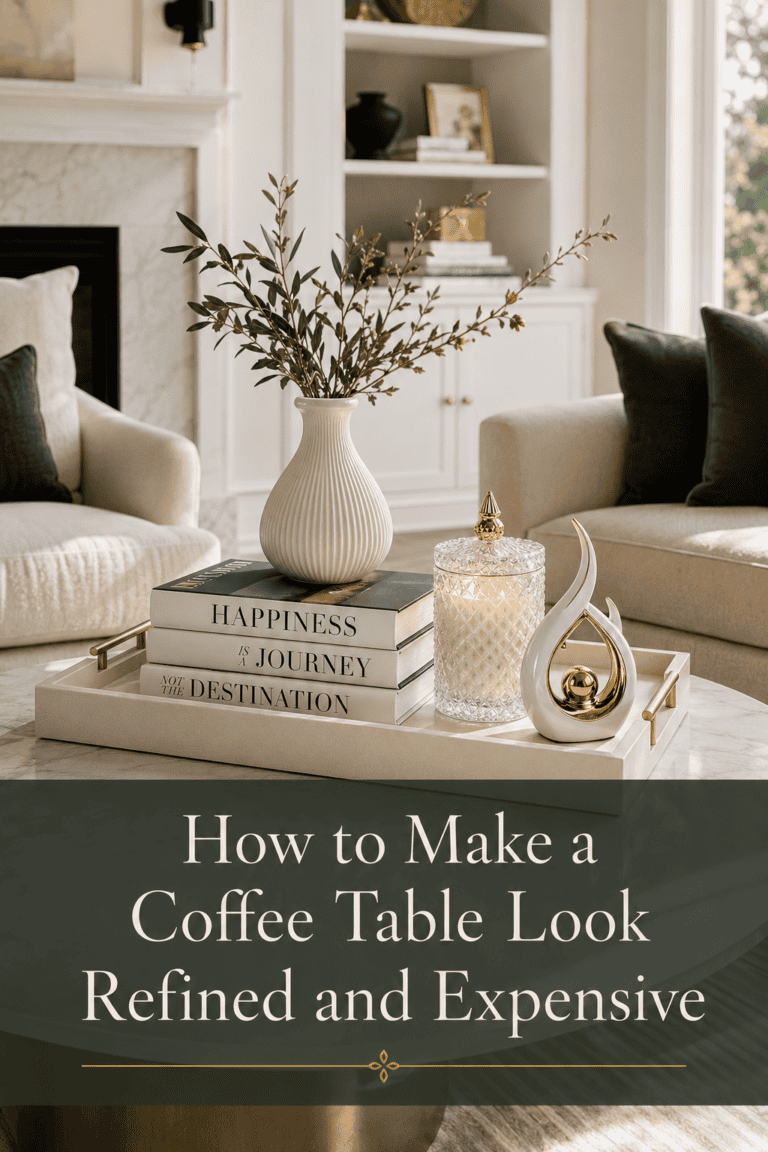
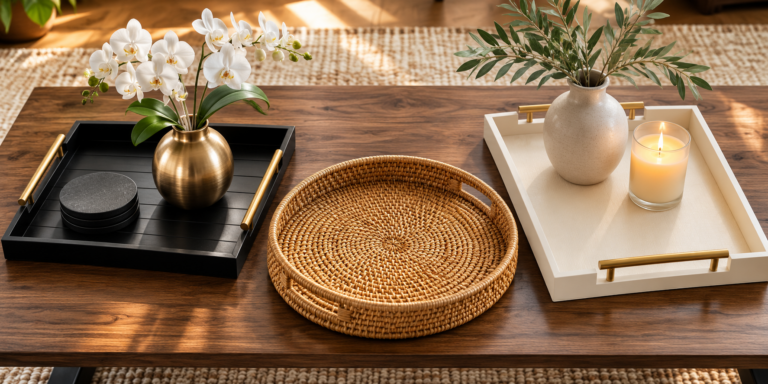
This is the one mistake that causes almost everything else on this list. Without a tray, every object on your coffee table is competing for its own space, a candle here, a coaster there, a remote wherever it landed. Nothing is grouped, so nothing reads as intentional, even if every individual piece is beautiful.
A tray does something almost sneaky. It draws an invisible boundary around a cluster of objects and tells your eye, “these belong together.” The same three items look scattered without a tray and styled with one.
Picture a coffee table with a candle on one side, a small plant on the other, and a stack of books somewhere in the middle. Even if none of those pieces are ugly, the table reads as messy because there’s no visual anchor. Now picture the exact same three items moved onto a single tray in the center. Same objects, same table, but now it looks curated instead of accumulated.
If your coffee table is on the smaller side, a tray isn’t mandatory. In that case, let your book stack do the anchoring work instead (more on that below). But for anything mid-size or larger, a simple wood, rattan, or lacquered tray is the fastest fix on this entire list.
Mistake #2: Everything Sitting at the Same Height
A flat coffee table, where every object is roughly the same height, reads as unfinished even when it’s not messy. Your eye needs somewhere to travel, and a table full of same-height objects gives it nowhere to go.
This is an easy mistake to make because it usually happens by accident. You add a candle, then a small dish, then another small object, and none of them individually seem like a problem. It’s only once they’re all sitting at the same eye level that the table starts to feel flat.
Here’s what that looks like side by side. A candle, a small ceramic dish, and a coaster, all roughly the same height, spread across the table: flat. Now compare that to a stack of two books with a candle placed beside them and a taller vase behind. Suddenly there are three distinct heights instead of one, and the table has actual visual rhythm.
The fix doesn’t require buying anything new most of the time. Look at what you already have and ask which piece could go under something else, or which piece could be swapped for something taller. A stack of books is often the easiest way to create a mid-height layer without adding a single new object to the room.
Mistake #3: Too Many Small Objects, No Editing
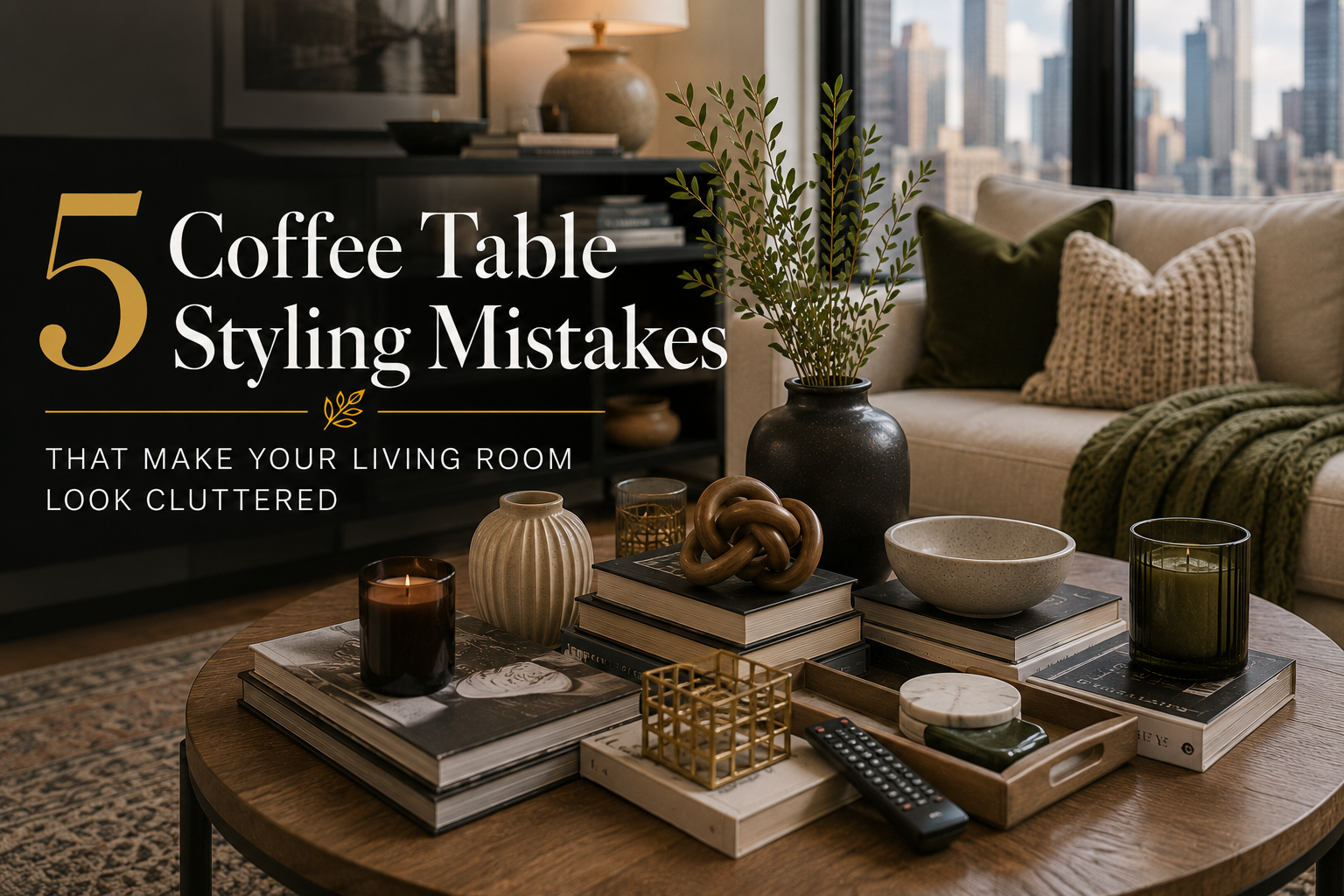
This is the opposite problem from mistake #2, and it’s just as common. Instead of everything sitting flat, everything is competing: five or six small decorative pieces, each one nice on its own, together reading as clutter.
The instinct to keep adding until the table feels “finished” is understandable. But a coffee table doesn’t need every pretty object you own sitting on it at once. It needs a few pieces with room to breathe.
Take a candle, a small dish, a mini sculpture, a coaster set, and a tiny vase, all within a few inches of each other. Individually, every one of those objects might be lovely. Together, there’s no breathing room, and the eye can’t settle on any single piece long enough to appreciate it. Now pull that same table down to three objects: the candle, the vase, one small dish. Suddenly each piece actually gets to be seen.
A rule that helps here: work in odd numbers, and stop once you hit three or five. If you’re reaching for a sixth object, that’s usually a sign you’re filling space out of habit rather than styling with intention.
Mistake #4: No Organic Element
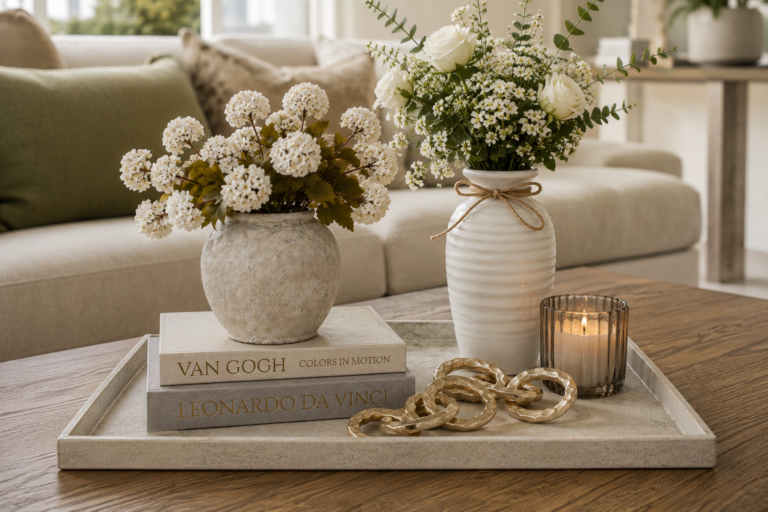
A coffee table styled entirely with hard, manufactured objects (trays, books, ceramics, candles) can start to feel a little cold, even when every piece is beautiful. What’s usually missing is something that isn’t perfectly uniform. A plant. A few stems in a low vase. Even a bowl of pinecones or dried citrus, depending on the season.
A tray, a stack of books, and a candle, all with clean straight lines and matte finishes, is nice but a little stiff. Add one small vase with a few loose branches or stems and the whole table softens. The organic shape breaks up all the straight edges without adding any real visual weight.
You don’t need fresh flowers replaced every week for this to work. A low-maintenance plant, a bundle of dried stems that will last for months, or even faux greenery with a matte finish (not glossy, that’s usually what gives it away) all do the job. The goal isn’t perfection here. It’s a small reminder that something in the room is alive, or was recently.
Mistake #5: Matching Everything Too Perfectly
This is the mistake that surprises people most, because it feels like it should be the opposite of a mistake. A table where the tray, the vase, the candle holder, and the books are all in the same tone, the same material, the same finish looks less like an intentionally curated space and more like a matching decor set bought all at once.
Real, lived-in styling almost always mixes materials: a wood tray with a ceramic vase, a glass candle holder next to a stone dish, a leather-bound book beside one with a linen cover. The slight variation is what makes a table look collected over time instead of purchased in a single trip.
A tray, vase, and candle holder that are all the exact same shade of white ceramic can look more like a boxed set than a styled table, even though nothing about them is wrong on its own. Swap just one piece, say a wood tray instead of a ceramic one, and the same grouping suddenly looks intentional instead of matched.
If you’re building a coffee table vignette from scratch, try to source your pieces from at least two or three different materials: one wood or rattan item, one ceramic or stone item, and one glass or metal item. You don’t need a large budget to do this. Thrifted pieces are often the easiest way to introduce a material you don’t already own.
Putting It Together
A tray to anchor the grouping. A few varied heights. An edited object count. One organic touch. A mix of materials instead of a matched set. None of these five fixes require redoing your whole living room, and most of them don’t require buying anything new. That’s really the whole formula, and it works whether your coffee table is a hundred-dollar find or an heirloom piece.
The table my friend so gently teased me about eventually became one of my favorite surfaces in the house, not because I found better objects, but because I finally arranged the ones I already had with a little more intention. That’s usually all a coffee table is asking for.
For more coffee table styling ideas, read our guides on how to make a coffee table look refined and expensive, how trays, books, candles, and vases work together, the simple formula for a perfectly balanced coffee table, and dark and moody coffee table decor ideas, and warm neutral coffee table decor ideas.