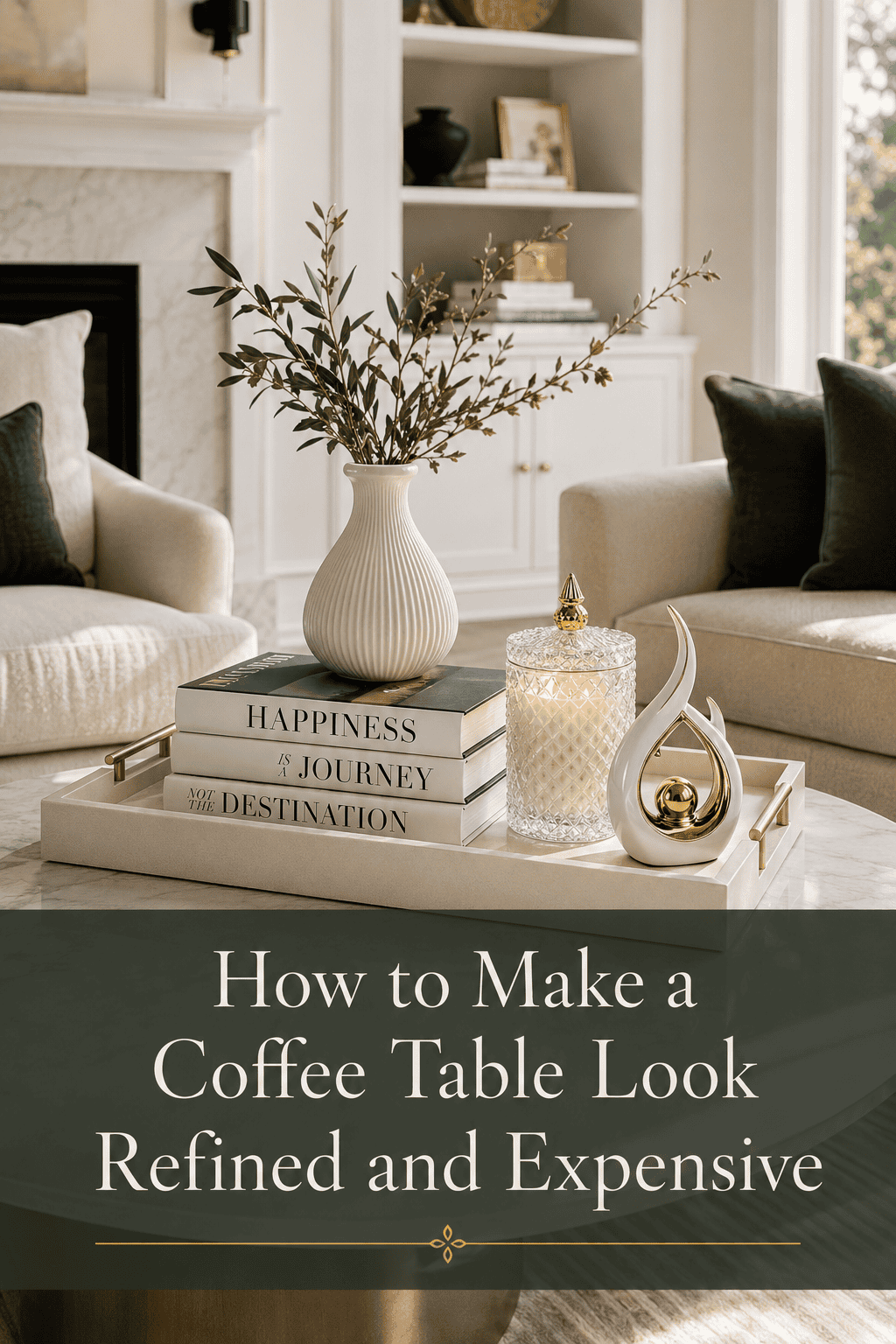
How to Style a Coffee Table That Looks Refined and Expensive
For the longest time, my coffee table was just a landing spot. Remote controls, a coaster from last week, mail I meant to deal with. I walked through a friend’s apartment once and stopped cold at her coffee table, not because it had anything expensive on it, but because it looked like someone had actually made a decision about it. Everything there had a reason to be there. That was the moment I realized the coffee table is one of the most-seen surfaces in any living room, and most of us have never really thought about it. I hadn’t, for years.
This post contains affiliate links. If you purchase through these links, I may earn a small commission at no extra cost to you. Thank you for supporting Harvest Edge Living.
The coffee table is one of the most-looked-at surfaces in any living room, yet it’s often the most neglected, a place where remotes, mail, and random clutter quietly accumulate. The difference between a coffee table that looks like an afterthought and one that looks intentionally styled almost never comes down to spending more money. It comes down to following a simple structure, and then editing ruthlessly. Here’s how to get it right, table shape by table shape, budget by budget.
Why Most Coffee Tables Look Cluttered or Empty
Coffee tables tend to fail in one of two directions. Either they’re completely bare (which looks unfinished and a little sad) or they’re piled with everything that didn’t have another home, which looks chaotic. Refined styling sits in the middle: a small, considered collection of objects, grouped with intention, leaving visible empty space around them. That empty space is doing as much work as the objects themselves. It’s what makes a styled table look calm instead of busy.
1. Start With a Tray as Your Foundation
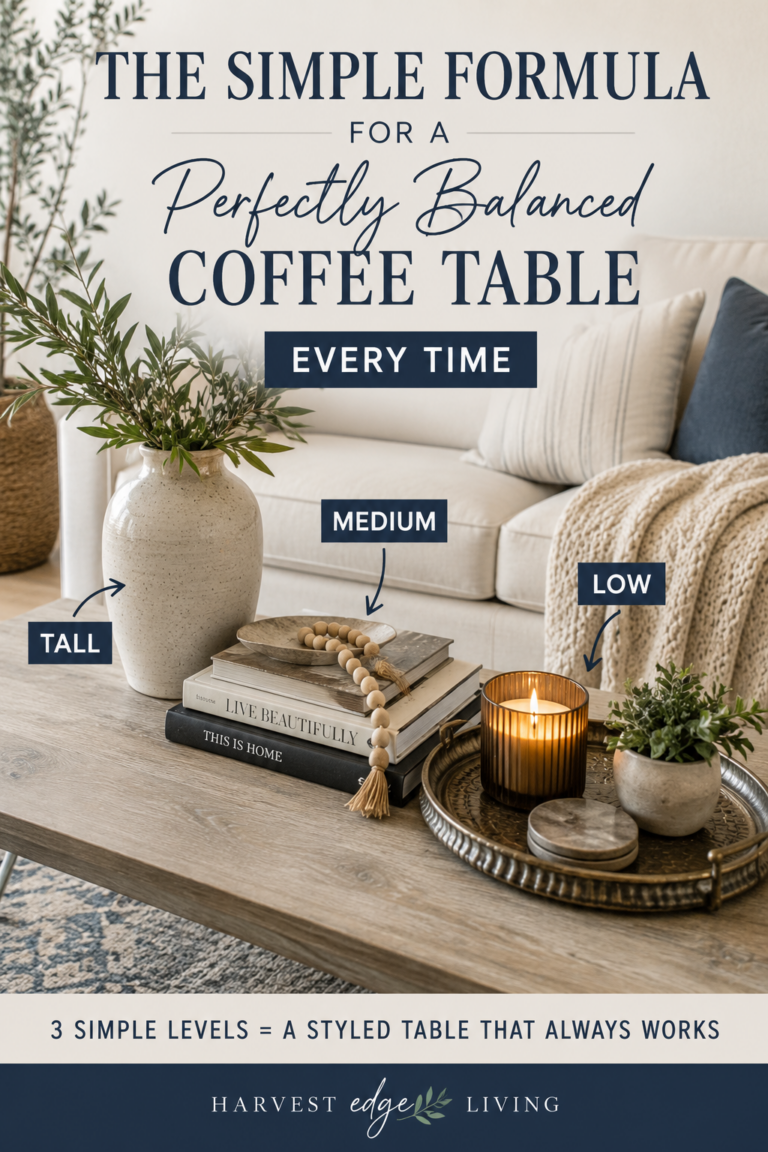
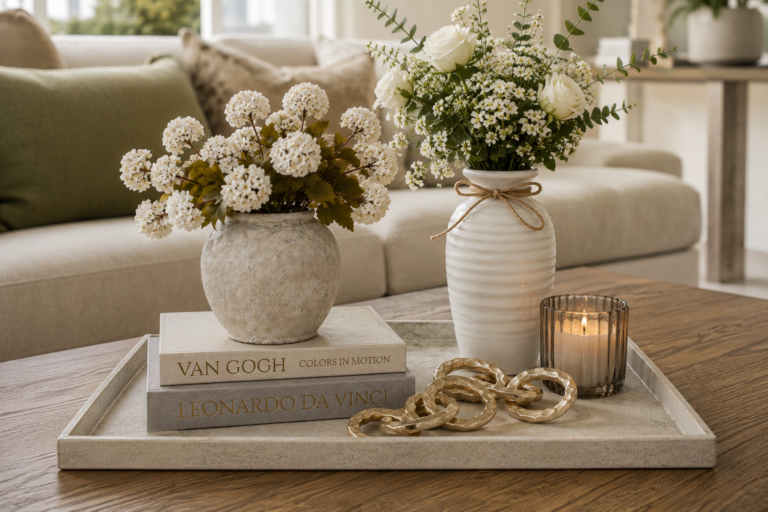
A tray is the single most useful tool for coffee table styling, and it’s the first thing to add if your table currently has nothing, or too much. A tray does two things at once: it visually corrals smaller objects into one organized zone, and it creates a defined “stage” that makes everything on it look deliberate rather than scattered.
Choose a tray in a material that contrasts gently with your table, a wood tray on a glass table, a matte black or brass tray on a wood table. Round trays soften a room full of rectangular furniture; rectangular trays work well on smaller or square tables where every inch of surface area matters.
2. Build in Odd Numbers and Varying Heights
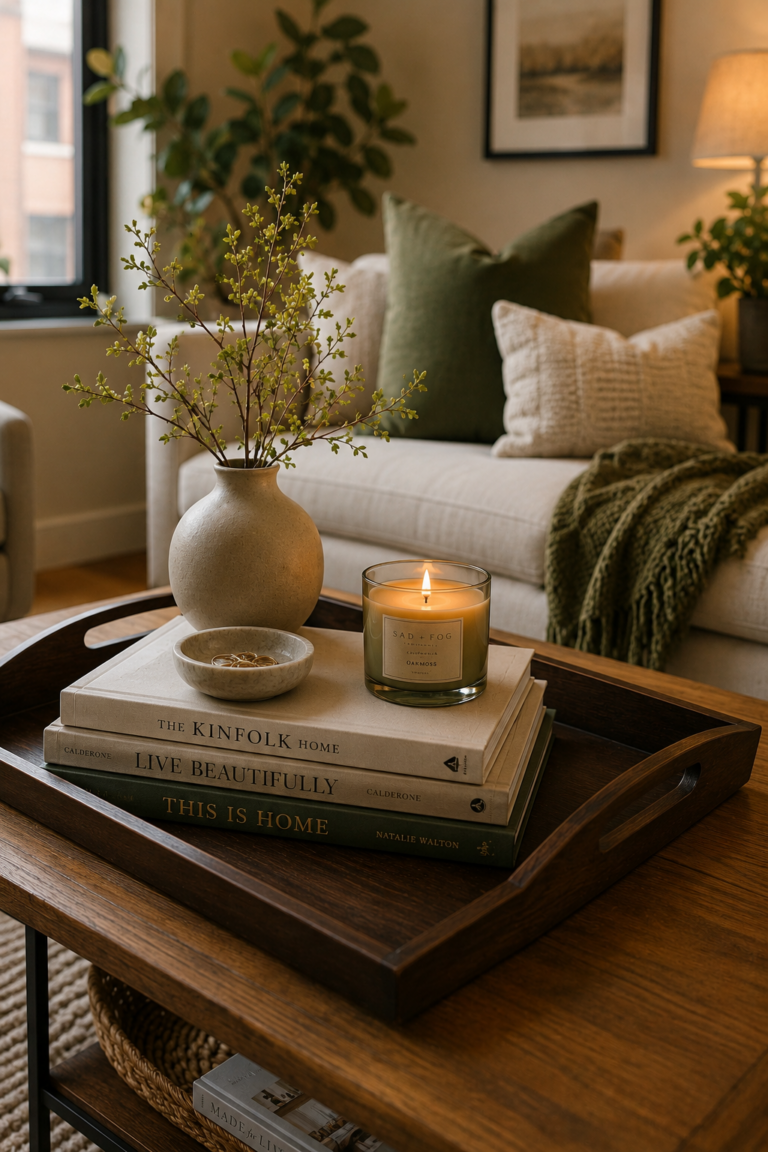
This is the single most reliable styling rule that exists, and it works on every surface in your home, not just coffee tables. Groupings of three (or five) look more natural and intentional to the eye than groupings of two or four. At the same time, vary the height of what you’re grouping, one tall object, one medium, one low and wide. A stack of books, a candle, and a small sculptural object is a classic three-piece combination that hits both rules at once.
3. Anchor With a Stack of Books
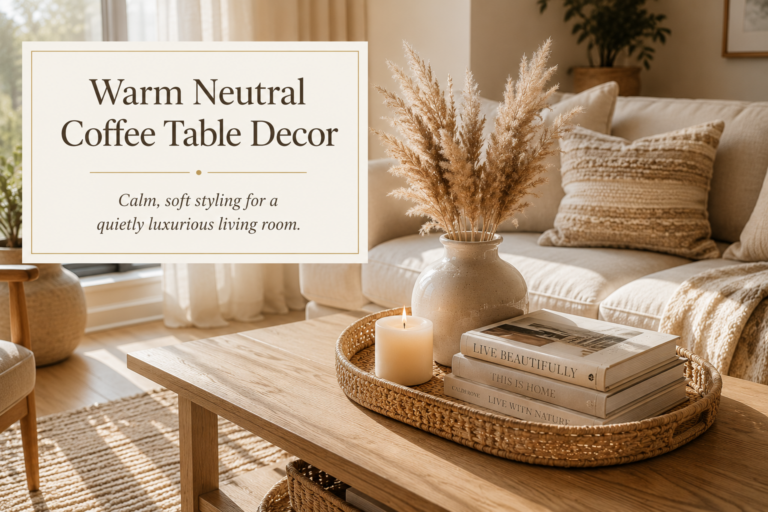
A stack of two or three coffee table books does more visual work than almost any other single object. Books add height, color, and texture, and they signal that a space is curated rather than purely decorative. Choose books with covers or spines you actually like looking at, art, architecture, photography, and travel books tend to photograph and display well. Stack them by size with the largest on the bottom, and consider placing a small object (a candle, a small dish, or a piece of stone) on top of the stack to break up the flat surface.
4. Add One Organic Element
Every styled surface benefits from something that isn’t manufactured, a small plant, a few stems in a low vase, a bowl of natural elements like dried citrus slices or pinecones depending on the season. This is what keeps a tablescape from feeling like a still life arranged purely for photos. Even a small, low-maintenance plant like a succulent softens the harder edges of books, trays, and candles.
5. Use Candles for Warmth, Even Unlit
A candle in a simple, well-made holder adds both height variation and a sense of calm to a coffee table, whether or not it’s ever lit. Pillar candles in matte ceramic or glass holders tend to look more refined than anything overly ornate. If you want function as well as style, choose a scented candle in a tone that fits the room, woodsy and warm for a living room, light and clean for a more minimal space.
6. Respect the Empty Space
This is the part people get wrong most often: once the tray, books, candle, and one or two more objects are in place, stop. The instinct is to keep adding until the table feels “finished,” but the negative space around your grouping is exactly what makes it read as styled rather than cluttered. A good rule of thumb is to cover no more than half the table’s surface, leaving the rest open for a drink, a remote, or simply visual breathing room.
Styling by Table Shape
The shape of your coffee table actually changes how you should approach styling it. A few adjustments by shape:
- Round tables pair best with a single centered grouping rather than objects pushed to one side, the circular shape draws the eye to the middle naturally.
- Rectangular tables have the most flexibility. Try one grouping at one end (tray, books, candle) and a single, simple object (a vase or small plant) at the opposite end to balance the table without crowding it.
- Square tables work well with one tray placed slightly off-center rather than dead-center, which avoids the symmetrical, “showroom” feeling square tables can fall into.
- Nesting tables should be styled as a set, keep the smaller table’s styling lighter (a single candle or small object) so it doesn’t compete with the main table’s grouping.
Styling on a Budget
None of this requires an expensive shopping trip. A few ways to style well without spending much:
- Use a tray you already own, a wood cutting board or a simple ceramic plate can function as a styling tray in a pinch.
- Borrow books from a shelf elsewhere in your home rather than buying decorative ones, well-loved books with worn spines often look more authentic anyway.
- A single stem from your yard or a grocery store bouquet, trimmed short in a small jar, does the same job as an expensive floral arrangement.
- Thrift stores and secondhand shops are reliable sources for trays, candle holders, and small bowls at a fraction of retail cost.
Rotating Your Styling Seasonally
A coffee table doesn’t need to look the same all year. Small seasonal swaps keep a space feeling current without any structural changes to your styling formula:
- Fall/winter: warmer candle scents, a small bowl of pinecones or dried oranges, deeper-toned books
- Spring/summer: a vase of fresh stems, lighter scented candles, brighter book covers
The tray, the book stack, and the overall structure can stay exactly the same, you’re only swapping the smallest, most affordable pieces.
Common Coffee Table Styling Mistakes
- Too many small objects with no grouping logic. Random trinkets scattered without a tray or tray-like boundary look messy no matter how nice each piece is individually.
- Everything the same height. A row of objects all the same size reads as flat and uninteresting, vary the height every time.
- No livable space left. If there’s nowhere to set down a coffee cup, the styling has gone too far.
- Skipping the tray. Without one, even well-chosen objects can look like they landed there by accident.
- Matching everything too perfectly. A few intentionally different materials and tones look more curated than a uniform, matched set.
- Ignoring the table’s shape. A styling approach that works on a rectangular table can look off-balance on a round or square one, adjust your grouping to the shape you have.
The Takeaway
A refined coffee table comes down to four things: a tray as a foundation, an odd number of objects at varying heights, one organic element, and restraint. Start with the tray and a stack of books (those two alone will transform most coffee tables) then add sparingly from there, adjusting your grouping to your table’s shape and swapping small details seasonally. The goal is a table that looks effortless, even though every piece on it was chosen on purpose.
Ready to shop the pieces that bring this look together? Visit our Shop the Look page for curated home décor finds.
For more coffee table styling ideas, read our guides on styling a coffee table in a refined small space, how trays, books, candles, and vases work together, five coffee table styling mistakes to avoid, the simple formula for a perfectly balanced coffee table, dark and moody coffee table decor ideas, and warm neutral coffee table decor ideas.
For more small-space apartment living ideas, read our guides on summer apartment living ideas for a refined small space and creating a luxury apartment atmosphere without feeling cold.
This post contains affiliate links. If you purchase through these links, I may earn a small commission at no extra cost to you. Thank you for supporting Harvest Edge Living.